48V Li-ion battery cell-replacement repair


Creator’s own settings as stated in the video (timestamps link to the moment). Not official values — test on scrap first.
Bill of materials
Welder, accessories, consumables and parts used in this build; quantities and specs are editable Download BOMDescription
A no-name e-bike's 48V Li-ion pack only goes one or two km: case not small but hollow inside, 18650 3P13S low-capacity cells, tester says 'battery condition extremely poor', not worth repairing; all replaced with EVE 2.5Ah in 4P13S = 48V 10Ah, honest capacity with no inflation, 30-odd km on an ordinary small bike; nickel-strip spot welding, BMS fitted, charge/discharge test
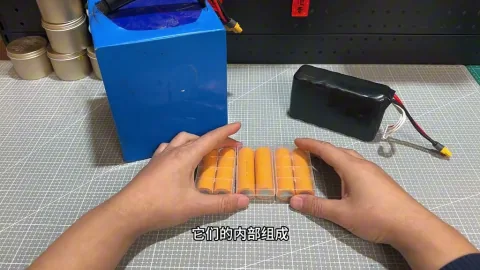
A 48V Li-ion battery; the customer says it only goes one or two km. No need to check the capacity: pick it up and you can tell the case isn't small but the cell capacity certainly is; no-name e-bikes off the internet all come with this kind; open it up and one section inside is empty; 18650 cells in 3P13S, ordinary low-capacity cells that won't last long even with light home use; test cell by cell with the resistance tester: readings 3.5–3.6V, resistance 16–24, screen says 'battery condition extremely poor, please service', no repair value at all. Replace everything: EVE 2.5 cells in 4P13S = 48V 10Ah, honest capacity with no inflation, an ordinary small bike will do 30-odd km no problem; spot-weld the cells in parallel and series with nickel strip; fit the BMS, charge/discharge test, battery done. 25 comments: many asking price (48V 10A / 30A / 5P13S, how much); 21700 5000mAh in 4P makes 48V 20Ah; lots of fake EVE cells, ¥2-odd each, zero volts after three months in storage; BAK 2900 without holders in 6P rides 60 km; a designated-driver bike's 48V 8Ah drops out as soon as the throttle turns, fixable?; Wuyang buyers got scammed with fake capacity.
Outcome
| Goal | Re-cell a no-name 48V battery to 4P13S 10Ah |
| Build | EVE 18650 2.5Ah ×52 + 13S BMS |
| Result | Assembled, finished after the charge/discharge test · not verified on camera |
Steps4 steps · click a frame to jump
 1. Diagnosis: only one or two km; big case, small cells, no-name e-bike stock
48V Li-ion only goes one or two km; no need to check capacity, case not small but cell capacity is; stock battery of a no-name e-bike; one section inside is empty.
00:08 – 00:42 2. Opened up: 18650 3P13S low-capacity cells; tester says 'extremely poor', worthless
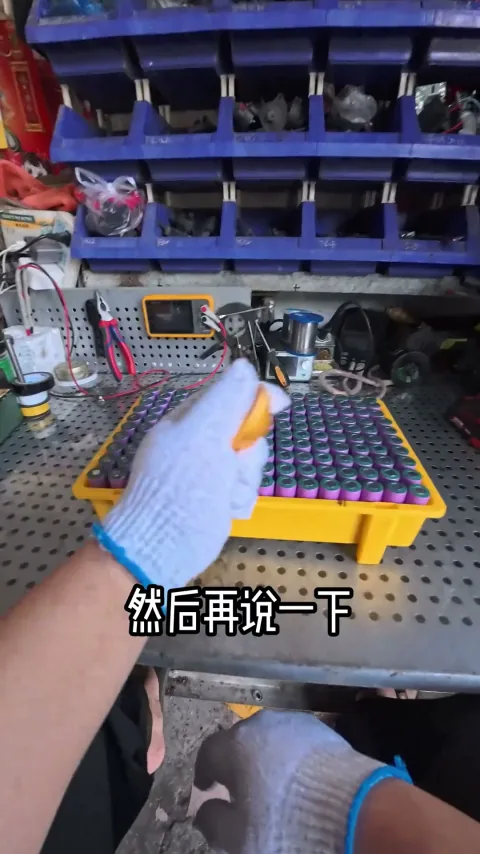
18650, 3P13S; ordinary low-capacity cells that won't last long even at home; tester cell by cell 3.5–3.6V, resistance 16–24, says battery condition extremely poor, please service; no repair value at all.
00:42 – 01:09 3. EVE 2.5Ah 4P13S = 48V 10Ah, no inflation; nickel-strip spot welding
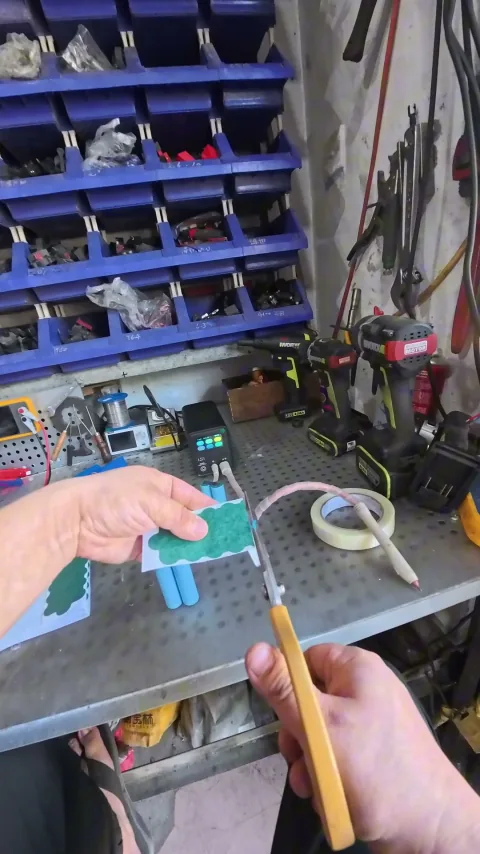
Replace all with EVE 2.5 cells, 4P13S 48V 10Ah, honest capacity with no inflation, an ordinary small bike does 30-odd km; nickel-strip spot welding for the parallel and series connections.
01:09 – 01:31 4. Fit the BMS, charge/discharge test
Fit the BMS; charge/discharge test; battery done.
01:35 – 01:44
Bill of materials
| No-name 48V battery ×1 | 18650 3P13S · Being re-celled |
| EVE 18650 ×52 | 2.5Ah · 4P13S |
| Internal-resistance tester (cell by cell) ×1 | Assessment |
| Nickel strip + spot welder (UF20B) | Welding |
| 13S BMS ×1 | Protection |
Measured on camera
| Old cell voltage / resistance (tester) | 3.56–3.64V / 16–24mΩ, condition extremely poor 00:56 |
Creator’s tips
- A big case doesn't mean big capacity; no-name e-bike stock packs often use low-capacity cells 00:22
- When the tester says 'extremely poor' you can call it not worth repairing and re-cell straight away 00:56
- 4P13S of 2.5Ah = an honest 10Ah, 30-odd km on a small bike 01:09
Pitfalls
- Comment: lots of fake EVE cells, ¥2-odd each, zero volts after three months in storage